Friday, March 15, 2013

5 methods of mining

     There are five methods of mining as show in session 3 of the WV coal project video. The various mining techniques include drift mining, Shaft mining,
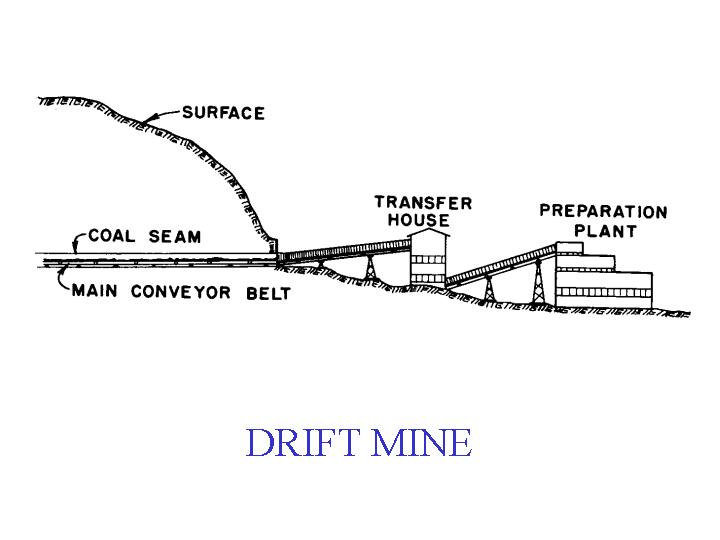
     Drift mining is where the coal seam intersects the surface. How this works is the mine intersects the seam horizontally following the coal. This is mainly used for mountains this is why it is popular in West Virginia. The advantages of drift mining is there is no mountain top removal. The disadvantage is that there is a lot more erosion after the mining is done on the mountains.
http://www.onemine.org/search/index.cfm/advantages-and-disadvantages-of-drift-and-fill-mining
     Shaft mining is the most common form of mining. They use elevators to access the coal. They are typically about 1000 feet deep in West Virginia. The advantage of shaft mining is that it goes deeper and gets out all the coal. The disadvantage of shaft mining is that it isn't as enviromentally friendly when you fill it in after all the coal is out. But it does keep the erosion of the mountain down.
http://www.miningmagazine.com/management-in-action/sinking-skilfully?SQ_DESIGN_NAME=print_friendly


     Room and pillar mining nearly half the coal is left behind to support the roof. Pillars can "squeeze" putting pressure on other pillars and causing it to collapse. The advantages of room and pillar mining is that it is a very cheap way to mine. The other advantages of room and pillar mining is it is fast. The big disadvantage is roof collapses are very common in this type of mining although with the progression of technology, this has become less of a hazard. but still a hazard none the less.
more on room and pillar mining


     Longwall mining is also known as retreat mining. The main way of Longwall mining is they use hydraulic to support the ceiling and do this with huge mining machines. Once the coal is removed the machine retreats and the ceiling collapses behind it. The advantage of this is that it gets a lot more coal out than room and pillar mining. The disadvantage to Longwall mining is that it is very costly.
longwall mining


     Strip mining is mainly used when coal is close to the surface or the overburden is unstable. As mining progresses , the overburden is placed on the previous mine cavity. the advantage to strip mining is less miners would get hurt in case of an accident. The disadvantage is that it isn't as eco friendly and not filled as well as other types of mining techiques.
strip mining


Monday, March 11, 2013

coal formation

Coal is formed when the remainder of a plant in a swamp goes beneath the surface and oxygen is cut off. the plant does not rot but forms peat.Then as the plant turns from peat to lignite. this happens when the absence of oxygen and more carbon is present. then after it forms lignite it turns into one of the many types of coal: Bituminous, anthracite, then coke. This is the way coal is formed.

Thursday, February 14, 2013

conclusions

     After I analyzed my graph I came to the conclusion that November was warmer than December. After I came to that conclusion I discovered that the AOT's were much larger in November. I have also discovered that the grass and AstroTurf is much warmer in December than it is in November. All of the data point to the fact that everything, besides grass, is cooler in December than November. When we went out to take temperatures in Vitriolic weather in December we had more comfortable weather in November. But December is when winter started. but in November it is a gentle decline where as December it as a sharper decline. The percent transmission has a sharp increase closer to the end of November and has several sharp decline's in December. December although, we had a lot more observations we could still take the same observation sites and put them in a graph and then we could still have this trend. This is a very important trend because I think that they are decreasing because we had a bit of snow so I think that the data showed that.

Monday, January 28, 2013

predict what effect aerosols may have on climate change

     Aerosols have many different things leading to climate change. Some of our handouts pointed out that they can cause the haziness over a city and that they can also reduce the affect of global warming. I think that aerosols might not have that big of an impact on climate change after all. I think that because we know so little about them the more we find out the littler they will have an effect on our precious Earth. our handout from the National Climatic Data Center says that energy from the sun has not increased but the sea level and snow caps have also risen. The handout also says how global CO2 levels have increased by a lot of PPB's. None of our packets directly say that aerosols have a direct part in the global warming other than the Urban Heat Island Effect. This is why I predict what I do.

Wednesday, November 7, 2012

solar radiation and aerosols

The sun and Earth are nearly 150 Kilometers apart. Ozone makes up a big part of the separation of the troposphere of Earth and the solar radiation coming from the sun. The gases are not what makes up the clouds but water vapor is. As gravity pulls earth to the surface it is measured in per square inch and milibars. and height is measured in kilometers. The Urban heat island effect is usually in place in big cities.
clouds are defined by their shape and form, cloud based altitudes, and if they are participating. the Humidity has a huge impact as well, because the water vapors are stuck between air molecules.

Saturday, October 13, 2012

Aerosols

Do you know why we need to research Aerosols?
 Aerosols are small partials suspended in air with a lifetime of at least minutes. They are either emitted as primary Aerosols, dust or partial emissions, or formed by the conversion of sulfur dioxide, Nitrogen oxides, ammonia, and organic compounds in atmospheric chemical reactions. The total mass of aerosols are a diameter of 10 Micrometers or smaller.
    Particulates, are tiny particles of solid or liquid suspended in the atmosphere. They range in size from just a few molecules to large enough that they can no longer be carried by air
    Aerosols come from everything from: Spray cans, sea salt, dust, decomposition, water evaporation, soot, tobacco smoke, smog, oil smoke, fly ash, cement dust, Viruses, Cat allergens, bacteria, house dust mite allergens, mold, and pollen.
  Aerosols have an effect on climate in two ways; Direct radioactive forcing the scattering of solar radiation and the absorption of terestrial radiation, and indirect radioactive forcing mainly by effects of aerosols on cloud properties. Greenhouse gasses also have a well understood effect on global radioactive balance and surface temperatures.
 environmental factors of aerosols are soot covering leaves on plants, smokestack gases (sulfur dioxide), and CFC's decomposition releases chlorine atoms. Aerosols also play a significant role in causing asthma attacks. Elevation makes some health problems worse with aerosols and also water depth in your region.
    Aerosols have been in use for century's but we really don't know a ton about them. We need to know more. If we know more we can use our knowledge to reduce the whole in the ozone or the heat island effect. Therefore, we need to study aerosols more than we already do.

Climate

Surface ozone should first be studied because we don’t know much about it. We think we know what harms it but do w e really know if it’s helpful or hurtful?
    The Ozone layer is formed naturally whenever sunlight or chemical reactions break oxygen molecules apart. The Ozone is a major product of air pollution and is an unknown abundance globally known.  Surface ozone is the concentration of local ozone in the layer a few meters above a particular ground site. The measurement used for measurements in surface ozone is unit of a partial pressure or mixing ratio.
    The Ozone layer absorbs solar energy that is dangerous to living organism and reaches the outer layer of the atmosphere. The excess amount of solar energy stays inside the planet and harms living things the marine ecosystem along the coast of Antarctica is taking the biggest hit because all the ice is melting. Increased levels of UV-B damage is also happening to humans we are experiencing damage to our internal organs, less immune systems, more blindness (physically), and skin cancer. The E.P.A.(environmental Protection Agency) says that every 1 percent of  the reduction of the ozone concretions increases very dangerous skin cells. We do not yet know what the affect is on other animals. We need to study it for these very reasons. Although, due to the Montreal protocol, an agreement between nations of the world to reduce CFC’s
    The Ozone layer of the atmosphere is beneficial and harmful to us. The higher up in the atmosphere (stratosphere) it filters out incoming radiation from the Sun and Ultraviolet rays (UV), without this layer our lives on earth would not have evolved this way. During the 1970's man-made CFC's were majorly released and caused the destruction of the Ozone layer, and caused destruction and letting much more radiation through causing more health problems for humans such as: skin cancers, eye cataracts, and a reduction in the body's immunity to diseases. 
    Volatile Organic compounds make all the difference  They are used as indoor air pollutants but are not measured as outdoor air pollution  VOC's are very hazardous and are regulated by the pipeline and hazardous safety administration. VOC's are mainly found in contaminated groundwater and has high vapor pressures. 
     This is why we should study the Ozone layer. We should study it because of CFC's, the unkown, and VOC's. this could change the world if we knew more about them. Therefore I hope that we can find out more about them